
Reading time: 7 min
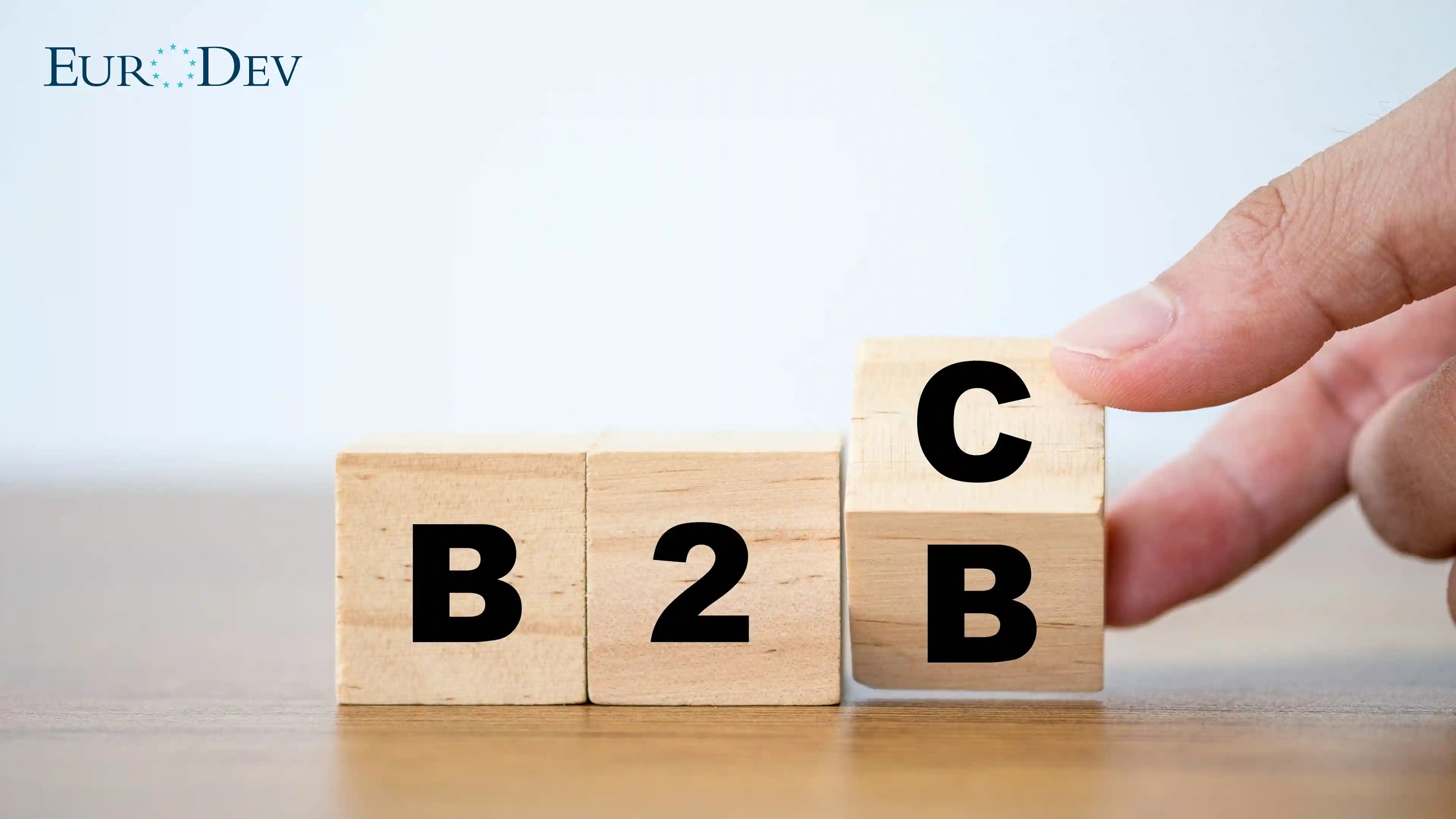
B2B and B2C marketing have traditionally operated very differently. B2C companies focus on individual consumers, often relying on emotion, convenience and quick purchasing decisions. B2B companies, on the other hand, typically deal with longer sales cycles, multiple decision-makers and products or services that require more explanation.
But the gap between the two is becoming smaller.
Digital experiences have changed what buyers expect from brands, whether they are purchasing a pair of shoes or researching a new business solution. For B2B companies expanding into Europe, some of the practices that B2C brands have mastered can offer valuable lessons.
Europe's B2C market also continues to demonstrate the scale of digital purchasing. European B2C e-commerce turnover reached €911 billion in 2025, growing 7% compared with the previous year, and is forecast to reach €961 billion in 2026.
So, what exactly can B2B marketers learn from B2C?
1. How Can B2B Companies Make the Customer Journey Easier?
One of the biggest strengths of B2C marketing is convenience.
Successful consumer brands reduce friction throughout the customer journey. Product information is easy to find, websites are intuitive, content answers questions quickly and the next step is usually obvious.
B2B purchasing is naturally more complex, but complexity should not translate into a complicated digital experience.
A potential customer visiting a B2B website should still be able to understand:
- What does the company offer?
- Who is the solution for?
- What problem does it solve?
- Why should they trust the company?
- What should they do next?
For B2B businesses targeting European customers, this becomes particularly important when the buyer is researching suppliers from another country. Clear service information, relevant case studies, local market knowledge and straightforward contact options can remove uncertainty early in the buying journey.
2. Should B2B Marketing Go Beyond Lead Generation?
B2B digital marketing has traditionally focused heavily on lead generation. B2C brands, however, often think about the entire customer journey, from discovery and engagement to purchase and retention.
Social commerce demonstrates how closely those stages are becoming connected. DHL's 2026 e-commerce research found that 63% of businesses sell on social channels, while 45% of shoppers purchase through social commerce channels.
Of course, a manufacturer or professional services company is unlikely to close a complex B2B deal through an Instagram checkout. The lesson is different.
Social media, search, website content, email and sales outreach should not operate as completely separate activities. Each touchpoint should help move the potential customer towards the next stage.
For B2B companies, a LinkedIn post may lead to a blog, the blog to a case study, and the case study to a conversation with the sales team.
That connected journey is something B2C marketing has been particularly effective at building.
3. How Can B2B Companies Localise the Customer Experience in Europe?
Europe cannot be approached as one homogeneous market.
Different countries have different languages, cultural expectations, purchasing behaviours and communication preferences. Simply translating an English campaign into German, French or Dutch does not necessarily make it locally relevant.
This applies particularly to companies entering Europe from North America.
EuroDev's internal marketing guidance also highlights the importance of localisation and the differences in communication styles between European markets. It notes that European B2B audiences can respond particularly well to factual messaging, technical expertise, customer success stories and proven results.
B2C companies have long understood the importance of adapting customer experiences to specific markets. B2B companies can apply the same principle by localising:
- Messaging and terminology
- SEO keywords and search intent
- Social media content
- Customer examples
- Landing pages
- Calls to action
- Sales and marketing materials
The goal isn't simply to speak the language. It is to make the company feel relevant to that particular market.
4. How Can B2B Companies Build a Brand People Remember?
In B2B, marketing can easily become product-focused.
Specifications, features, certifications and technical advantages matter, but they shouldn't be the entire brand story.
B2C brands generally invest heavily in creating recognisable identities and consistent customer experiences. B2B organisations can benefit from doing the same.
That doesn't mean replacing technical content with entertaining social posts. It means combining expertise with a brand that feels recognisable, trustworthy and human.
Strong branding is not exclusively a B2C strategy. In competitive European B2B markets, credibility and recognition can be just as important as demonstrating technical capabilities.
5. Are You Creating Content for Companies or for People?
B2B stands for business-to-business, but marketing messages ultimately reach people.
Procurement specialists, engineers, CEOs, HR managers and distributors all have individual concerns, pressures and priorities.
That is another area where B2C thinking can help.
Instead of communicating only what a company does, B2B marketing should address what its audience is actually trying to accomplish.
Rather than:
"We provide innovative solutions for European businesses."
Consider something more concrete:
The second version starts with the customer's problem rather than the company's offering.
The same principle can guide blog topics, advertising, LinkedIn campaigns, landing pages and email marketing.
6. How Can B2B Marketers Use AI to Improve Relevance?
Artificial intelligence has become impossible to separate from discussions about modern digital marketing.
But having access to AI does not automatically make marketing better.
Both B2B and B2C organisations can now use technology to support marketing activities. The real differentiator is how effectively those capabilities translate into relevant customer experiences, valuable content and measurable business results.
For B2B organisations, particularly those operating across several European markets, the opportunity is not simply to produce more content. It is to become more effective at delivering the right content to the right audience and market.
Does B2B Marketing Need to Become More Like B2C?
Not exactly.
A €20 pair of headphones and a six-figure industrial solution will never have the same buying journey.
B2B sales often require technical expertise, stakeholder alignment, personal relationships and considerably longer decision-making processes. Those characteristics should not disappear from B2B marketing.
Instead, B2B companies can take the strongest principles from B2C marketing and adapt them:
Make buying easier. Build a recognisable brand. Understand the customer. Localise the experience. Connect marketing channels. And communicate like there is a person on the other side of the screen.
Bringing B2B Marketing to Europe
For North American companies entering Europe, applying those principles becomes more challenging.
What works in the US may need to be adapted for different European languages, markets and audiences. At the same time, building separate marketing capabilities in every target country can quickly become resource-intensive.
EuroDev helps North American B2B companies develop and execute digital marketing strategies for the European market, combining European market knowledge with services across SEO, social media, advertising, email marketing and website development.
Looking to strengthen your B2B digital marketing presence in Europe? Get in touch with our European Digital Marketing team.
Main change: I made all six core headings questions and also changed the concluding B2B-vs-B2C section into a question, so the article flows more like an educational guide rather than a list of statements.

Related articles
-
GEO for B2B vs SEO: What Actually Changes in 2026
Last updated: 26 October 2026GEO for B2B explained: how generative engine optimization differs from SEO, what to change in 2026,...
Read more -

Search Everywhere Optimization: Why SEO Is No Longer Just About Google
Last updated: 28 August 2026SEO is no longer just about Google. Discover how Search Everywhere Optimization helps brands stay...
Read more -
Zero-Click Marketing: Why Winning Visibility Matters More Than Winning Clicks
Last updated: 30 July 2026Learn what zero-click marketing is, how AI is driving the trend, and how brands can adapt their...
Read more