
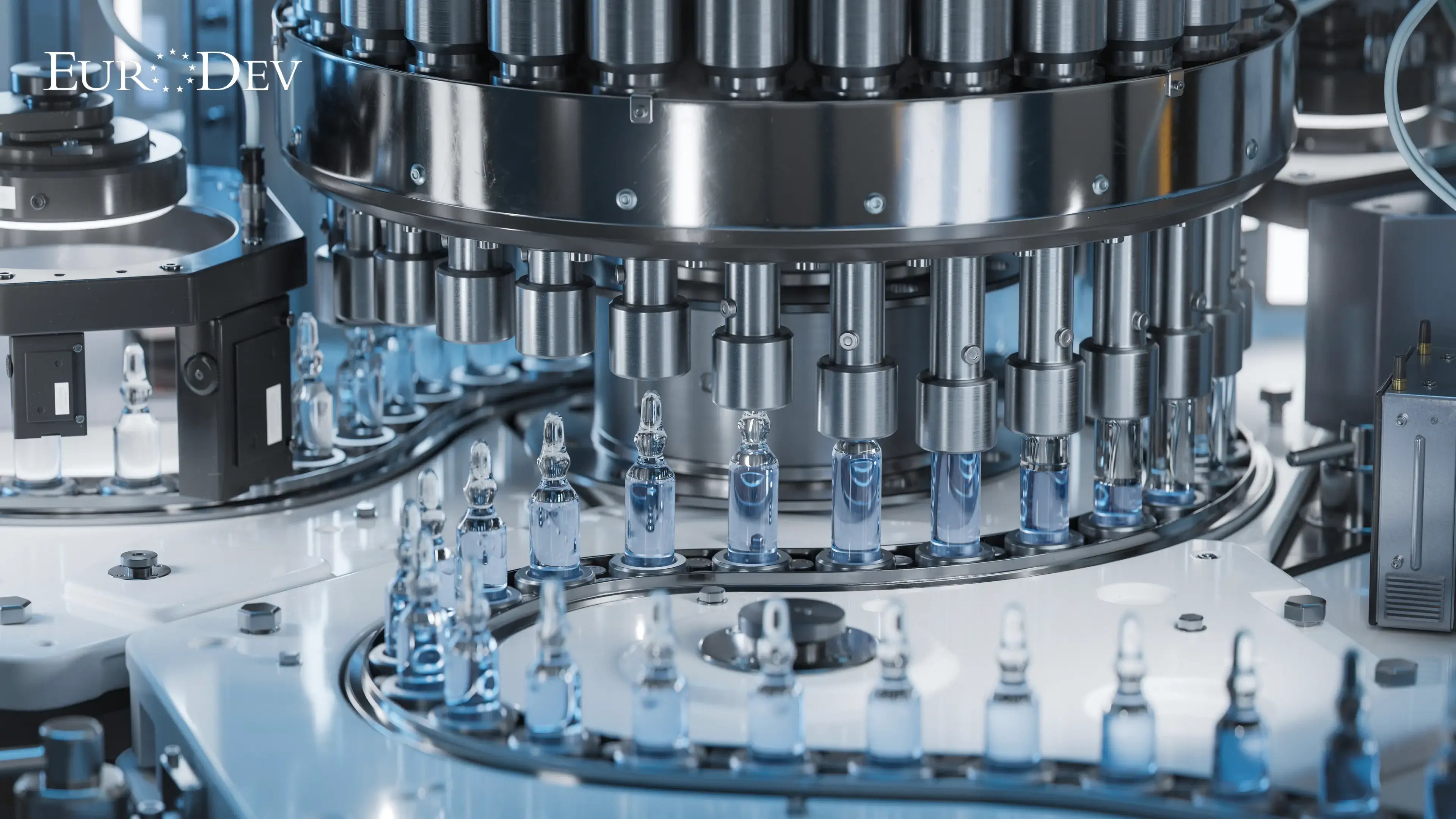
Over the past few years, the European pharmaceutical industry has undergone accelerated change. While global crises exposed vulnerabilities in research, manufacturing, and supply chains, they also highlighted the need for more resilient, digital, and data‑driven operating models.
Today, pharmaceutical companies across the EU are adopting technologies and organisational changes that strengthen the full product lifecycle, from research and development to production, logistics, and commercialisation. Below are the key structural trends shaping the EU pharmaceutical industry.
How are logistics and supply chains changing in the EU pharma industry?
Supply chain resilience has become a strategic priority for pharmaceutical companies in Europe.
Manufacturers, logistics providers, and public institutions are increasingly working together to modernise distribution networks, strengthen cold‑chain infrastructure, and improve visibility across supply chains. Digital solutions supporting scheduling, inventory management, and real‑time tracking are now widely embedded to improve medicine availability, quality, and affordability.
The EU pharmaceutical supply chain is shifting from a cost‑optimisation model to one focused on continuity, traceability, and risk mitigation, particularly for temperature‑sensitive and critical medicines.
Why are digital workflows becoming standard in pharmaceutical operations?
The EU pharmaceutical industry continues to move away from manual and paper‑based workflows that introduce risk and inefficiency.
Digital systems such as electronic lab notebooks, digital batch execution, and real‑time manufacturing dashboards are now central to ensuring data integrity, regulatory compliance, and process consistency. These tools support quality oversight, reduce clerical errors, and enable faster decision‑making throughout development and production.
For manufacturers supplying or operating in the EU, digital workflows also support compliance with European regulatory requirements around batch control, product release, labelling, and traceability, particularly when operating across multiple markets.
How is forecasting and crisis preparedness evolving in pharma?
Pharmaceutical companies are increasingly using predictive technologies to improve planning and operational stability.
Advanced analytics, equipment monitoring, and predictive maintenance tools help reduce unplanned downtime and mitigate supply disruptions before they occur. These capabilities support faster responses to demand fluctuations and operational challenges.
In parallel, outsourcing strategies are playing a growing role in maintaining continuity during disruptions. European pharmaceutical companies increasingly rely on specialised partners to maintain production capacity, manage regional differences, and support cross‑border operations during periods of uncertainty.
Why is raw data becoming more important in EU pharmaceutical regulation?
The value of raw and structured data continues to increase across the pharmaceutical industry.
Regulators and manufacturers alike are placing greater emphasis on data transparency, accessibility, and reuse to improve decision‑making and review processes. Structured access to clinical and manufacturing data supports more efficient analysis, improves reliability, and can shorten review timelines.
This shift reinforces the need for robust data governance, standardised formats, and systems capable of supporting advanced analytics across the product lifecycle.
How are modelling and simulation shaping pharmaceutical R&D?
Simulation and modelling technologies are becoming increasingly important in pharmaceutical research and development.
These tools allow companies to design, test, and optimise processes with fewer physical resources and shorter development cycles. Modelling supports faster scale‑up, improved reproducibility, and more informed decisions under constrained conditions.
In addition, simulation‑based training and digital learning environments are expanding across Europe, enabling consistent education for clinicians, researchers, and stakeholders without compromising quality or access.
What does this mean for international pharmaceutical companies?
For companies entering or expanding within the EU, these trends highlight the importance of adaptability, digital readiness, and operational resilience.
Manufacturers that align early with EU expectations around data integrity, digital workflows, supply chain robustness, and regulatory transparency are better positioned to scale sustainably and mitigate future risks.
Key Takeaways
- The EU pharmaceutical industry is shifting toward resilience and long‑term stability
- Digital workflows now support compliance, quality, and efficiency
- Supply chains prioritise continuity and traceability over cost alone
- Data transparency and accessibility are increasingly important
- Modelling and simulation are accelerating R&D and training
Written by the MedTech & Life Sciences team at EuroDev.

Related articles
-
The 10 Mistakes US MedTech Companies Make When Entering Europe
Last updated: 27 August 2026Discover the 10 biggest mistakes US MedTech companies make when entering Europe, from MDR...
Read more -
MDR vs. FDA 510(k): Where U.S. Playbooks Break in Europe (and How to Fix Them)
Last updated: 2 March 2026Learn the key differences between FDA 510(k) and EU MDR, including classification changes, clinical...
Read more -
Expanding Non-Invasive Monitoring Tech into Europe: A Path for North American Innovators
Last updated: 26 August 2025Europe’s healthcare systems need scalable, non-invasive monitoring tools. Discover key...
Read more